

News · INERTIA Advisory LLC · Tegucigalpa, August 2026
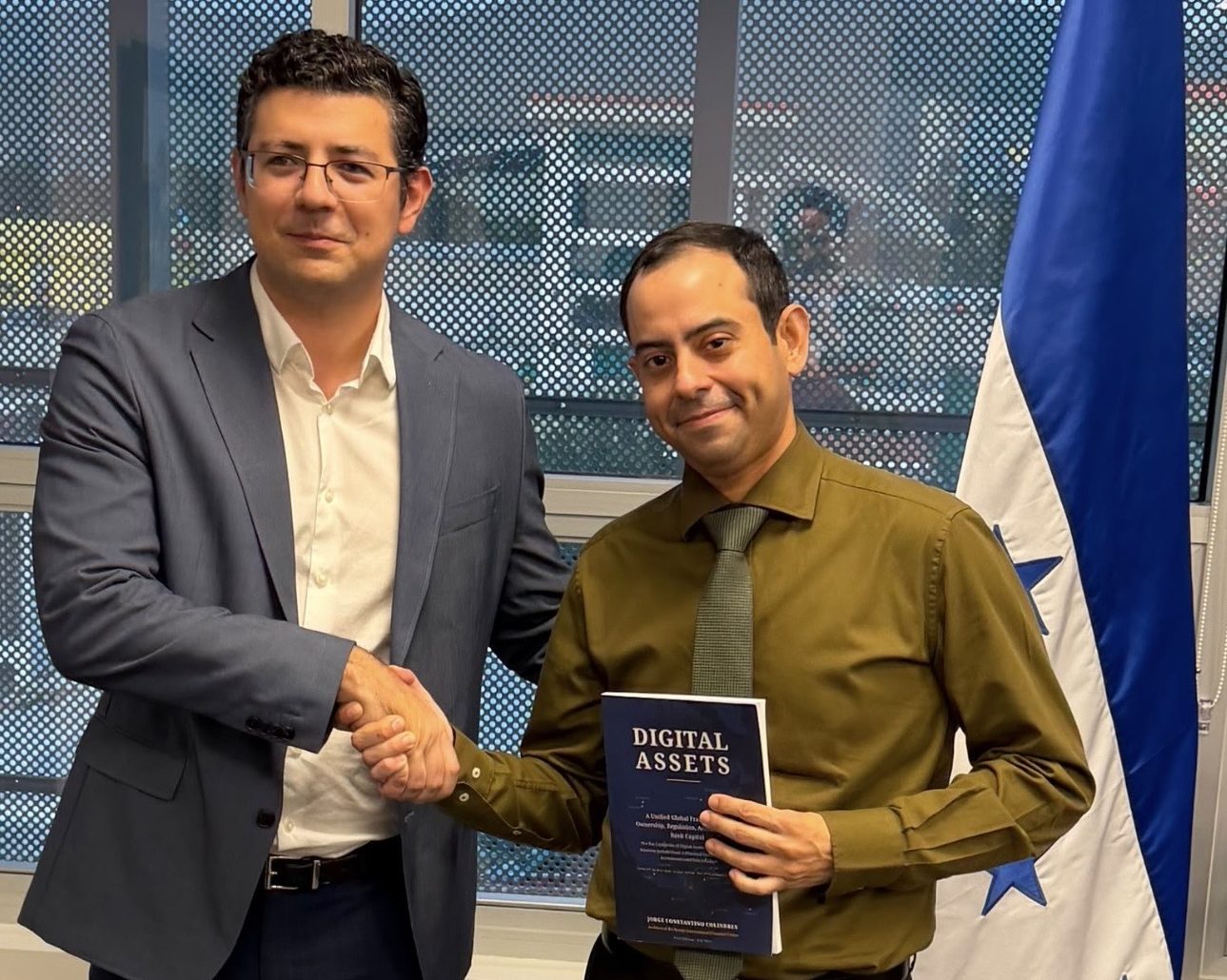
Our Founding Partner, Jorge Constantino Colindres, has presented the first copy of Digital Assets: A Unified Global Framework of Ownership, Regulation, Accounting and Bank Capital to Doctor Nicolás J. García Pineda, Commissioner President of the Comisión Nacional de Bancos y Seguros of Honduras.
The first copy of a first edition is given once. It was given this month, in Tegucigalpa, to the head of the national financial supervisor.
The moment is one of inflection. Honduras is developing a new regulatory framework to integrate digital assets into the national financial system, the most consequential question now before the Commission and one that cannot be resolved by a single policy choice. It has to be answered asset by asset, and answered across four disciplines at once.
That is the work the book does. Its method is stated in one sentence and honoured throughout: ask what the holder owns, ask which rulebook governs, and the accounting, the capital and the insolvency outcome follow. On that basis it builds a taxonomy of ten categories of digital assets in five families, from native protocol tokens and payment stablecoins to tokenised securities, NFTs, fiscal tokens and central bank digital currencies, and traces each category through nineteen jurisdictions and the global standard setters, with the operative definitions of UNIDROIT, the FATF, the Financial Stability Board, the Basel Committee and the SEC quoted verbatim, ready to be lifted into an opinion, an application or a rulebook.
The international reference points are settled and the book maps them directly. FATF Recommendation 15 fixes the perimeter for the virtual asset service provider, requiring that the risk be identified and understood and that the provider be licensed or registered, supervised and subject to anti money laundering obligations. The Basel cryptoasset standard, SCO60, in force since 1 January 2026, fixes the prudential price of bank exposure. US GAAP now carries qualifying crypto assets at fair value through earnings, while IFRS holds the ordinary holder to the intangibles model. A national framework that tracks those definitions is a framework foreign banks, correspondents and supervisors can read without translation.
The book was not written from a library. It began as a working paper at a desk in Roatán, as its author designed and deployed the regulatory framework of the Roatán International Financial Centre for global interoperability, and it states the law as at 1 July 2026 across an asset class of roughly USD 2.3 trillion.
INERTIA Advisory advises issuers, investors, family offices and financial institutions on the classification and structuring of digital asset products, financial services licensing, custody and segregation arrangements, accounting treatment under IFRS and US GAAP, and cross-border regulatory strategy, working alongside the licensed fiduciary, brokerage and custody capabilities of our economic group.
Digital Assets: A Unified Global Framework of Ownership, Regulation, Accounting and Bank Capital (first edition, July 2026, INERTIA Advisory LLC, Roatán; the law stated as at 1 July 2026) is available on Amazon.
The author’s ongoing analysis appears at Il Commercialista.
The book is written in the author’s personal and professional capacity; the analysis and views expressed are his own and do not state the official position of any institution with which he is affiliated.


Leave a Reply