

News · INERTIA · Madrid, September 2026
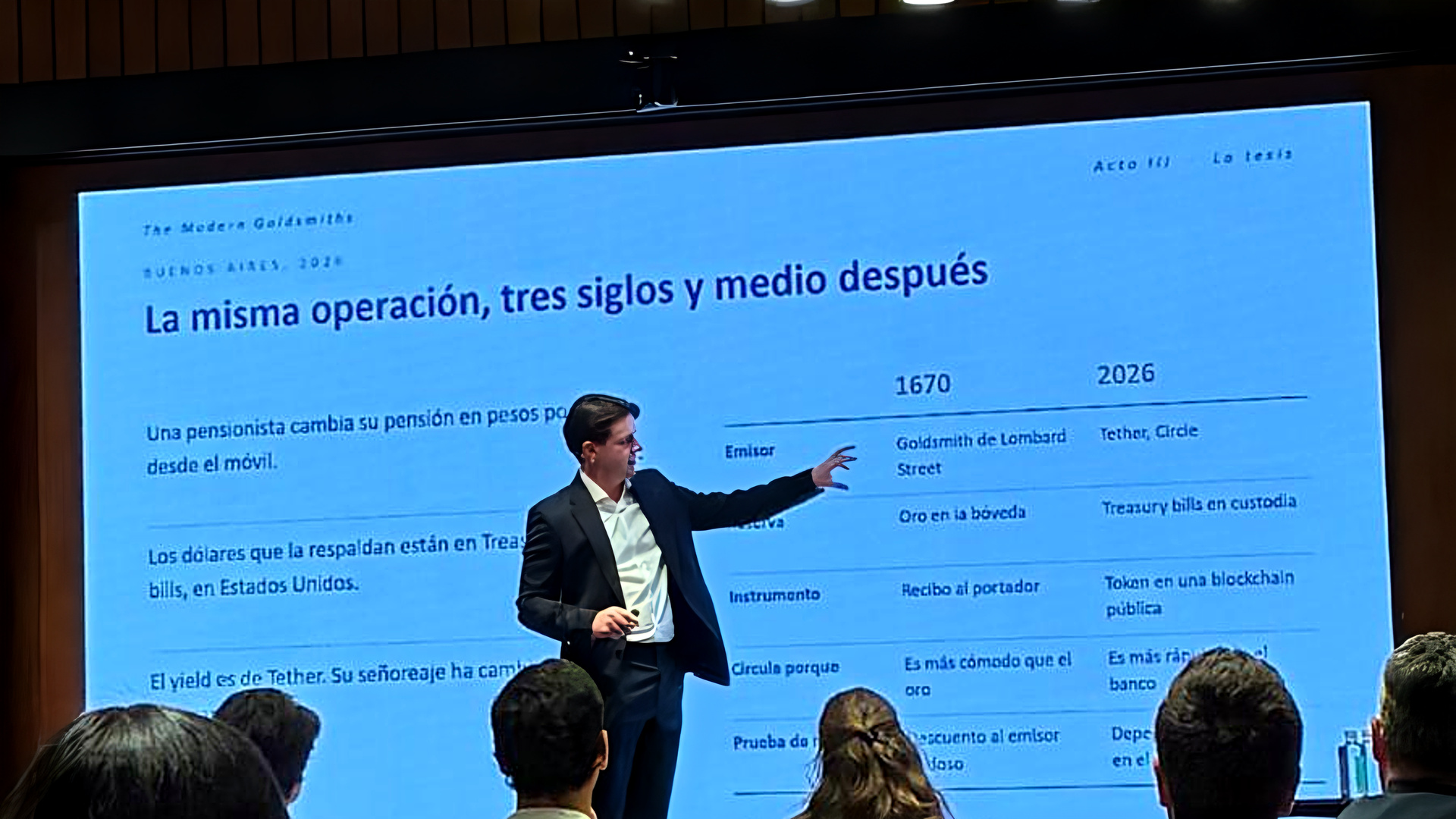
On Thursday, 17 September 2026, Danel Calvillo Armendáriz presented The Modern Goldsmiths: How Stablecoins Are Reshaping the International Monetary System at the Hotel Thompson in Madrid. The audience brought together representatives of BBVA, Banco Santander, the Universidad de Navarra, Dentons, special economic zones, and a broad group of fintechs and digital asset service providers. The book is available now on Amazon.
“I promise to pay unto the bearer on demand the sum of…” With the formula printed on the notes of a London goldsmith around 1670, Danel Calvillo Armendáriz opened an evening that moved across three and a half centuries of monetary history in under an hour, and arrived at a single question that legislatures on three continents are now answering at the same time: who may issue instruments that circulate as money, and on whose terms?
The setting suited the subject. Madrid is where the book began, and the room held the institutions whose history and future the argument touches directly: the banks that once issued their own notes and are now preparing to issue tokens, the university where the idea was born, and the firms building the rails on which the new money already moves.
From a classroom recommendation to a first edition
The author traced the origin of the book to 2020, in the Master’s in Banking and Financial Regulation at the Universidad de Navarra, when Professor Germán López Espinosa recommended Fragile by Design, Calomiris and Haber’s political history of banking crises. In its pages the goldsmiths of seventeenth-century London appeared for the first time, and the comparison never let go. Six years followed: a thesis on central bank digital currencies, a crypto index fund listed on the Frankfurt Stock Exchange, the licensing of Motus LLC and its role as a global USDT distributor, and in 2025 a full working paper. “The complete thesis proved unreadable,” he told the audience. “The book is the version that can be read.”
Five acts, one argument
The presentation followed the structure of the book in five acts.
The goldsmiths. A London goldsmith first acted as a custodian, holding gold against bearer receipts, and then became a banker, lending against the vault while the receipts circulated as money. That private settlement lasted two generations, until the Stop of the Exchequer in 1672, the founding of the Bank of England in 1694, and the Bank Charter Act of 1844 brought issuance under the sovereign.
The Spanish case. In 1857 the Banco de Bilbao issued its own bearer notes. On 19 March 1874 the Banco de España obtained the national monopoly in exchange for a loan of 125 million pesetas to the State, never repaid; the Banco de Bilbao called it “a true expropriation” in its annual report. The author showed a Banco de Bilbao note of one hundred reales de vellón, series F, still attached to its counterfoil with the date left blank, one of seventeen undated blocks preserved in the BBVA historical archive. The same house is today BBVA, a founding member of Qivalis, the consortium that will issue private euro money. One hundred and fifty-one years separate the revocation of the privilege from its return.
The thesis. Dollar stablecoins are the programmable successor to the EuroDollar: dollars created and circulating outside the domestic perimeter, serving a demand the domestic system does not reach. The figures presented were stark. USD 303 billion in circulation as of 12 September 2026; roughly USD 220 billion of US government debt held by issuers; more than 80 percent of transactions outside the United States. A remittance of USD 200 costs on average 6.5 percent through traditional channels and under one dollar by stablecoin, settled in minutes. A pensioner in Buenos Aires converting pesos to USDT from her phone, and a saver in Lagos whose deposit resurfaces as a Treasury bill, are not speculating. They are buying protection, and demand of that kind does not reverse when prices fall.
The architecture. The GENIUS Act in the United States and MiCA in the European Union, the author argued, are two cages for the same animal: custodian yes, banker no. Both require full reserves, both forbid paying yield to the holder, and both return to the non-bank a version of the note the Bank of England once took from the goldsmith. The reserve yield, roughly 3.8 percent and some USD 12 billion a year, accrues to the issuer and not to the holder. The prohibition, in his reading, is distributive rather than prudential, and it erodes under regulatory competition.
The outcome. History offers the pattern only one ending: private innovation, systemic importance, sovereign absorption. Not by prohibition, but through backing: central bank liquidity and formal designation. A late-stage reserve hegemon has created by statute a new buyer of its own debt, and that buyer is becoming systemic.
An argument written to be tested
The presentation closed on the feature that most distinguishes the book: eight dated, falsifiable markers, from the final GENIUS Act rules due by January 2027, to a systemic issuer accessing central bank liquidity by the end of 2028, to issuer Treasury holdings approaching USD 500 billion, to the perimeter of yield under the CLARITY Act and the MiCA review. “An argument that cannot fail does not deserve the reader’s attention,” reads the final slide of the section. By 2028 every reader will be able to check the thesis against the record.
“The goldsmiths are back,” the author concluded. “The real unknown is who will end up governing the system that rules their notes.”
About the book
The Modern Goldsmiths runs to fourteen chapters in four parts (The Historical Pattern, The Instrument, The Architecture, The Reckoning), with nineteen exhibits, a sixty-term glossary, chapter takeaways, a methodological appendix and a full bibliography. It is written for central bankers, regulators and policymakers; commercial and private bankers; treasury, payments and markets professionals; stablecoin issuers and investors; and every serious reader asking who may issue money, and on whose terms.
Danel Calvillo Armendáriz is Managing Partner of Business Development Group LLC and Director General of the Office of Trade & Investment, and teaches stablecoins and digital assets in the Master’s in Banking and Financial Regulation at the Universidad de Navarra. He began his career in BBVA’s Blockchain & Digital Assets division and was a founding contributor to the Roatán International Financial Centre.
From the book to the mandate
The questions the book poses in principle are the questions INERTIA resolves for clients in practice: stablecoin and digital asset licensing before the Roatán Financial Services Authority, reserve, custody and segregation structures, cross-border payment and treasury corridors, and market entry into Honduras and its ZEDEs. Readers who wish to put the argument to work are invited to contact our team.
The Modern Goldsmiths: How Stablecoins Are Reshaping the International Monetary System (first edition, July 2026, INERTIA Advisory LLC; hardcover, ISBN 9798188580773) is available now on Amazon:


Leave a Reply